

Landing graduate teaching roles in international schools sounds like the perfect next step after finishing your degree. You get to travel, work with diverse students, and build your career in education.
The reality? You'll face obstacles that nobody mentions during career planning sessions or in those glossy recruitment emails. Some are about paperwork, others about money, and a few catch you completely off guard.
This guide covers the barriers that stop qualified teachers before they even reach the interview stage. You'll learn what actually stands in your way so you can plan around these issues instead of discovering them too late.
Why Credential Recognition Stops Graduate Teaching Roles
Credential recognition evaluates your foreign degree against local education standards. The process takes 3–6 months and costs over $1,000 before you can apply to schools. Most graduates don't plan for either, and it often leads to three problems.
Different Countries Value Your Degree Differently
Evaluation agencies use different frameworks to assess qualifications, so results vary across countries. Your bachelor's degree might be recognized as a diploma in some regions, which downgrades your credentials entirely.
Credit hour mismatches create similar problems. Your four-year university program could be valued as three years elsewhere because coursework requirements don't match what certain countries expect for teaching positions. A master's degree from the UK might not carry the same weight in Asia or the Middle East.
Local Certification Requirements Add Years to Your Timeline

Many countries require local teaching certification on top of your existing degree. University programs rarely mention this during enrollment, so graduates only discover it when applying to schools abroad.
You're looking at 12-18 months for certification programs, plus thousands more in costs once you find out. Each country requires specific exams tied to its education system. Schools won't interview candidates without in-country certification, which eliminates you immediately, regardless of your qualifications.
Processing Delays Cost You Job Opportunities
Document evaluation alone takes 8-12 weeks before certification steps even begin. Schools fill teaching roles in 4-6 weeks, so your qualifications often sit in review while positions disappear.
We've worked with graduates for 15 years, and timing ruins more opportunities than anything else. Rush processing fees add $500-800 to speed things slightly, but even paying extra might not save a time-sensitive role. By the time your paperwork clears, the position is gone.
The Money Problem Everyone Skips Over
The average graduate spends $5,000-7,000 just to start an international teaching position before earning a single paycheck. That number catches most people off guard because nobody mentions it during those exciting job interviews.
So where does it all go? The first expense is credential evaluation services at $200-400 per degree, and you'll need multiple copies for different applications. That's not all. Each evaluation covers one institution, so if you have both undergraduate and graduate credentials from separate universities, you're paying twice.
When you factor in visa costs, the expenses keep climbing. Application fees run $300-1,000, depending on the country. Medical exams and background checks? That’s another $400. Some positions also need apostille stamps on documents, and that adds $20-50 per paper.
The real wallet-drainer is relocation itself. You're looking at $3,000-5,000 covering flights, temporary housing, furniture, and security deposits.
While many teaching jobs abroad offer benefits like housing allowances, those usually kick in after you arrive and complete paperwork. And that's all before you've earned your first paycheck. The salary range for entry positions might look good on paper, but upfront costs can break the bank if you haven't saved aggressively beforehand.
Visa Roadblocks That End Careers Before They Start

Visa complications end more teaching careers than rejections do. Schools discover sponsorship issues only after deciding to hire you, which wastes months of your time.
There are five specific roadblocks that stop qualified graduates:
- Labor Market Testing Requirements: Schools must prove that no local candidates qualify before sponsoring you. This process takes 2-4 months minimum because immigration laws require detailed documentation showing the school has exhausted its personnel search locally first.
- Quota Limitations: Visa quotas fill up fast in popular teaching destinations. Countries like Canada have annual caps on work permits for education positions, so schools can't hire you even when they want to. Once those numbers hit, job opportunities disappear regardless of qualifications (and there's nothing you can do about it).
- Processing Delays: You could lose a confirmed job offer because your paperwork didn't clear on time. Schools need teachers to start on specific dates to maintain compliance with their academic calendar. Miss that window, and they move to the next candidate.
- Changing Documentation Rules: Document requirements shift without notice. Suddenly, you're scrambling to gather new paperwork and pay additional fees. One country might require notarized translations, while another adds biometric screenings.
- Exit-Entry Requirements: Some countries require you to exit and re-enter for visa stamping. This adds travel costs and risks to an already stressful job search.
You can't control visa quotas or processing times, but knowing these exist helps you target realistic opportunities instead of wasting months on dead ends.
Can You Teach Without Perfect Fluency?
It depends on the school, but most expect near-native fluency in their language of instruction, even if you studied your entire master's degree in that language.
The issue isn't reading textbooks or writing lesson plans. Parent communication requires cultural nuance beyond textbook language, and interviews often expose these gaps. You might explain a student's progress perfectly in academic terms, but families want conversational explanations that feel natural and reassuring.
Colleagues use local idioms and informal language in meetings too. When teachers discuss classroom management strategies or education policies, they're not using the formal instruction language you learned in coursework. The gap between your master's degree language skills and workplace language becomes obvious quickly.
International schools need teachers who can handle parent complaints, lead staff meetings, and explain complex concepts to students using everyday language. Academic fluency doesn't automatically translate to that.
Graduate Assistantships vs. Full Teaching Positions

Graduate assistantships ease you into teaching, but international schools need someone managing 150 students across five classes without supervision.
The gap between these roles is bigger than most graduate students realize. Here's what actually separates them:
| Graduate Assistantships | International Teaching Positions |
| Support one instructor's curriculum | Develop an entire curriculum independently |
| Teach 10-15 hours per week | Handle 25-30 contact hours plus duties |
| Receive structured supervision daily | Make classroom decisions alone |
| Focus on one or two classes | Manage 5-6 different classes |
| Limited parent communication | Regular parent meetings and updates |
Graduate assistantships involve supporting one professor's curriculum, while international positions demand developing entire programs independently. That change alone overwhelms most graduates because you go from implementing someone else's plan to creating everything from scratch.
The supervision structure changes completely, too. Assistantships give you daily feedback and guidance, but international schools expect you to manage classrooms alone. When a lesson fails, or a student struggles, there's no experienced teacher down the hall to consult (you're it).
On top of that, you're facing twice the workload. Teaching 10-15 hours per week as an assistant doesn't prepare you for 25-30 contact hours plus administrative duties, parent meetings, and full responsibility for student outcomes. The workload gap hits harder than the teaching gap.
From our experience helping graduates find jobs, the shock usually hits around week three when they're handling everything solo.
Family Ties: The Relocation Challenge Nobody Mentions
Moving abroad means missing family milestones like weddings, births, and emergencies when you're thousands of miles away. Video calls help, but they don't replace being there when your sister has a baby or your parent gets sick. Unlike a gap year or semester abroad, this distance isn't temporary.
The impact extends beyond your own family ties. If you're married or in a committed relationship, your partner's career becomes part of the equation. One of you lands the teaching job while the other can't work legally for months or years. Your household suddenly runs on a single income in an unfamiliar country with different costs of living.
For those with children, the stakes get higher. Finding good schools, helping kids adapt to a new culture and language, and managing their emotional adjustment while you're also adjusting. It all compounds.
Some graduates even turn down excellent teaching positions simply because the family logistics don't work, regardless of how attractive the job itself looks.
Why Schools Want Experience You Don't Have Yet
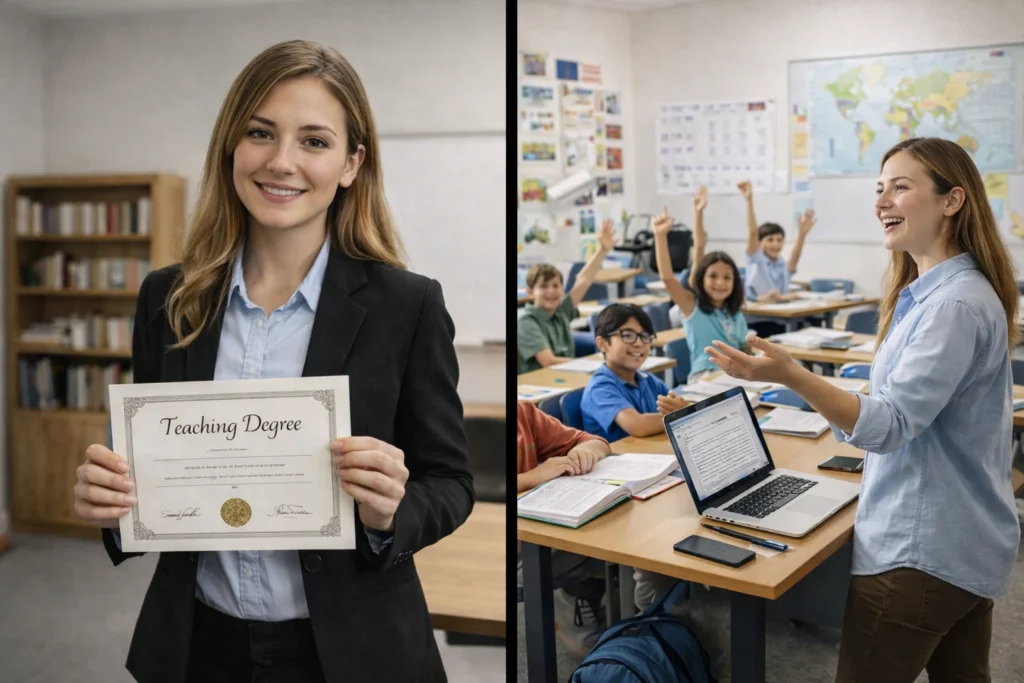
You're applying for teaching jobs abroad, and every posting has a 2-year experience requirement. Feels frustrating, right? Well, that's because many international schools won't even look at fresh graduates.
The reason comes down to risk. Research on international school recruitment shows that prior full classroom responsibility is one of the strongest screening factors, even when candidates meet academic requirements.
That's why schools search for teachers who've already handled difficult parents, behavioral issues, and curriculum challenges in their home country. They can't afford to let you learn on the job with their students.
The positions you can actually get require experience you can't build without getting hired first. And your graduate assistantship hours don't count as real teaching experience on your resume. The result? You lose out to more experienced candidates even when you're otherwise qualified.
How to Build Your Profile While You're Still Here
These barriers stop graduate students from landing international teaching jobs, but understanding them puts you ahead of candidates who discover these issues too late. You can prepare for credential recognition timelines, save aggressively for upfront costs, and research visa requirements before applying.
Start building relevant experience now. Volunteer in local schools, take on full classroom responsibilities where possible, and develop skills that distinguish you from other graduates. Target countries with more flexible requirements or look into programs that help recent educators gain the experience schools want.
At Arizona-Observatory, we've been helping graduates find international teaching positions for 15 years. We match your qualifications to realistic opportunities and help you build the profile schools actually want. Get in touch to see how we can support your job search.